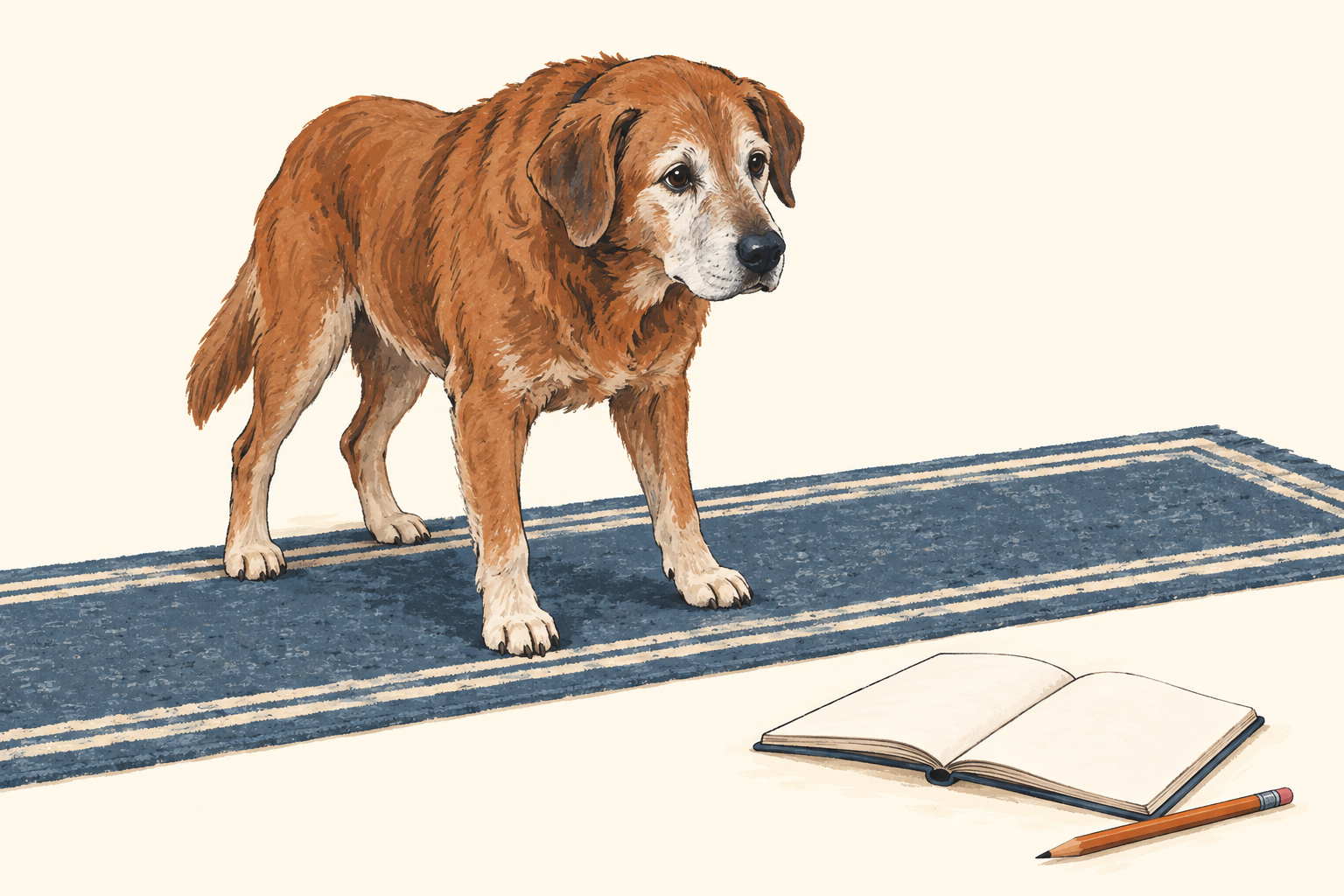
Start by watching your dog complete ordinary routines, not by buying several mobility aids at once. Map the routes to food, water, sleeping areas and the usual exit; record exactly where movement or navigation changes; then try one reversible environmental adjustment and compare what happens. This can reveal practical obstacles without treating a home experiment as a diagnosis.
Keep your veterinarian informed about behavior changes rather than dismissing them as inevitable aging. The ASPCA notes that such changes can accompany medical disorders that may be treatable. Your audit should therefore support a veterinary conversation, not postpone or replace one. [s4]
Map the routes that matter every day
Sketch each floor your dog uses and mark the bed, water, food, door, favorite resting place and any furniture the dog is allowed to access. Draw the actual path between them. Note transitions such as smooth flooring to carpet, narrow turns, thresholds, steps and places where people commonly leave objects.
Walk each route at your dog’s pace during the times it is normally used. Instead of writing “struggles indoors,” identify the location and action: hesitates at the kitchen threshold, slips while turning toward the water, pauses before one step, or approaches the bed from several directions without settling. Include routes used after dark as well as in daylight.
- Mark essential destinations and the shortest unobstructed route to each one.
- Record the floor surface and any step, threshold, tight turn or movable obstacle on each route.
- Repeat the observation at different routine times instead of relying on one unusually good or difficult trip.
Describe the problem before choosing the aid
Sort each observation by task: starting, stopping, turning, climbing, jumping, lowering to rest, rising, locating a destination or settling overnight. Then describe what you can see without assigning a cause. “Rear feet slid outward when turning” is more useful than “weak hips,” and “stood beside the wrong door at night” is clearer than “confused.”
Also record whether the event is consistent or occasional. Context may include time, lighting, recent activity, household noise, the presence of visitors and whether anyone was home. A short video may help preserve the sequence for your veterinarian, provided you can record without making the dog repeat a difficult task.
- Write the visible action, location and time before adding any interpretation.
- Note whether the dog completed the task independently, abandoned it or accepted ordinary assistance.
- Do not stage slips, jumps or stair attempts to obtain a recording.
Match one reversible change to one observation
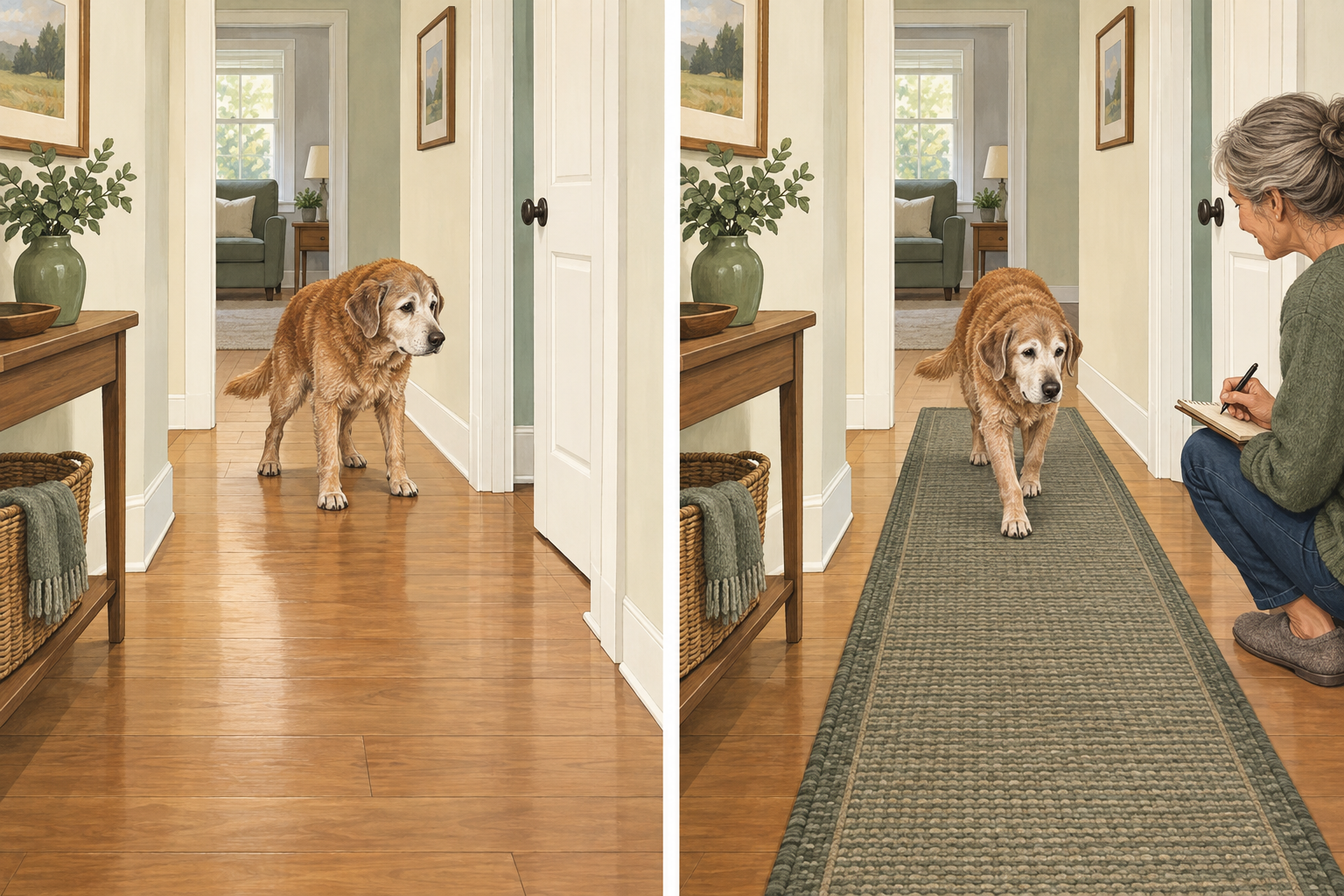
Use the smallest change that addresses the obstacle you observed. The AKC suggests non-slip rugs or yoga mats for traction. It also notes that a path with a distinct material can help a visually impaired dog navigate among essentials such as food, water, an exit and a bed. Secure any trial route so it does not create curled edges or new obstructions. [s3]
- If paws slide on a specific stretch, try a securely placed traction surface only along that route; track slips, hesitation and route completion.
- If the dog loses the route to an essential destination, keep furniture positions stable and consider one continuous, distinct-feeling path; track wrong turns and pauses.
- If jumping is difficult but balance and agility remain good, pet stairs are one option. The AKC recommends deep steps, an anti-skid surface and a suitable weight rating. Measure the destination and available floor space before selecting anything. [s1]
- If stairs cannot be managed, consider a ramp with a gentle slope, non-slip surface and sufficient weight capacity, as recommended by the AKC. Check that the full setup can sit securely in the available space before use. [s2]
- If getting into bed is difficult, first test a lower, accessible resting location near the usual spot; track whether the dog chooses it and can rise from it.
Run a one-change home experiment
Keep the normal routine as steady as practical and change only one environmental feature at a time. Choose a defined task, such as traveling from the living-room bed to the exit. Record several ordinary attempts before the change, then observe the same task afterward. Avoid declaring success from a single attempt.
Judge the trial using visible outcomes: fewer pauses, no new avoidance, easier completion or no meaningful difference. Stop using a setup if it appears unstable, blocks another route or introduces a new difficulty. A neutral result is still useful because it prevents you from layering more equipment onto a poorly matched idea.
Worked example: a dog repeatedly hesitates and slips only while turning from smooth hallway flooring toward the back door. The owner records the time, direction of travel and surface, then adds one secured traction path without changing the door routine. After observing ordinary trips, the owner can tell the veterinarian whether slipping, hesitation or route choice changed.
Build a vet-ready observation log
For nighttime restlessness, the ASPCA recommends record-keeping to help identify triggers. Useful context includes daytime sleeping, sensory changes, apparent discomfort and an increased need to eliminate. Record what occurred before, during and after the episode rather than using a broad entry such as “bad night.” [s5]
Presence matters too. The ASPCA notes that behavior occurring only during an owner’s absence may have different implications from behavior also seen while family members are home. Use a camera only if it is already a safe, unobtrusive part of the home; otherwise record what you find on departure and return without drawing conclusions. [s6]
- Log date, time, room, route, task and lighting conditions.
- Describe the exact action and how long the episode appeared to last, using the clock when possible rather than guessing.
- Note recent activity, daytime sleep, eating, drinking, elimination and any nighttime waking you directly observed.
- Record whether the dog was alone, with family or around visitors when the change occurred.
- Name the environmental change, when it began and what visibly improved, worsened or stayed the same.
Prepare measurements and questions before the appointment
Bring a concise timeline, your route map, selected videos and the log rather than a list of assumed causes. Highlight the first noticed change, whether it is becoming more frequent, and which daily tasks are affected. Include every home aid already tried, including trials that made no difference.
For equipment discussions, bring your dog’s current weight from a reliable record, the product’s stated weight rating, destination height, available floor space and photographs of the relevant route. Ask which activities should be avoided or modified while the change is being evaluated, and whether the veterinarian wants additional observations from daytime, nighttime, home-alone periods or family-present periods.
- Measure the height, width, landing space and approach area where steps or a ramp would sit.
- Check the aid’s stated weight capacity, surface grip, stability and effect on surrounding walkways.
- List all new mobility, navigation, sleep, elimination and behavior observations, even if they seem unrelated.
- Write down what differs between daylight and darkness, and between times when someone is home and when the dog is alone.