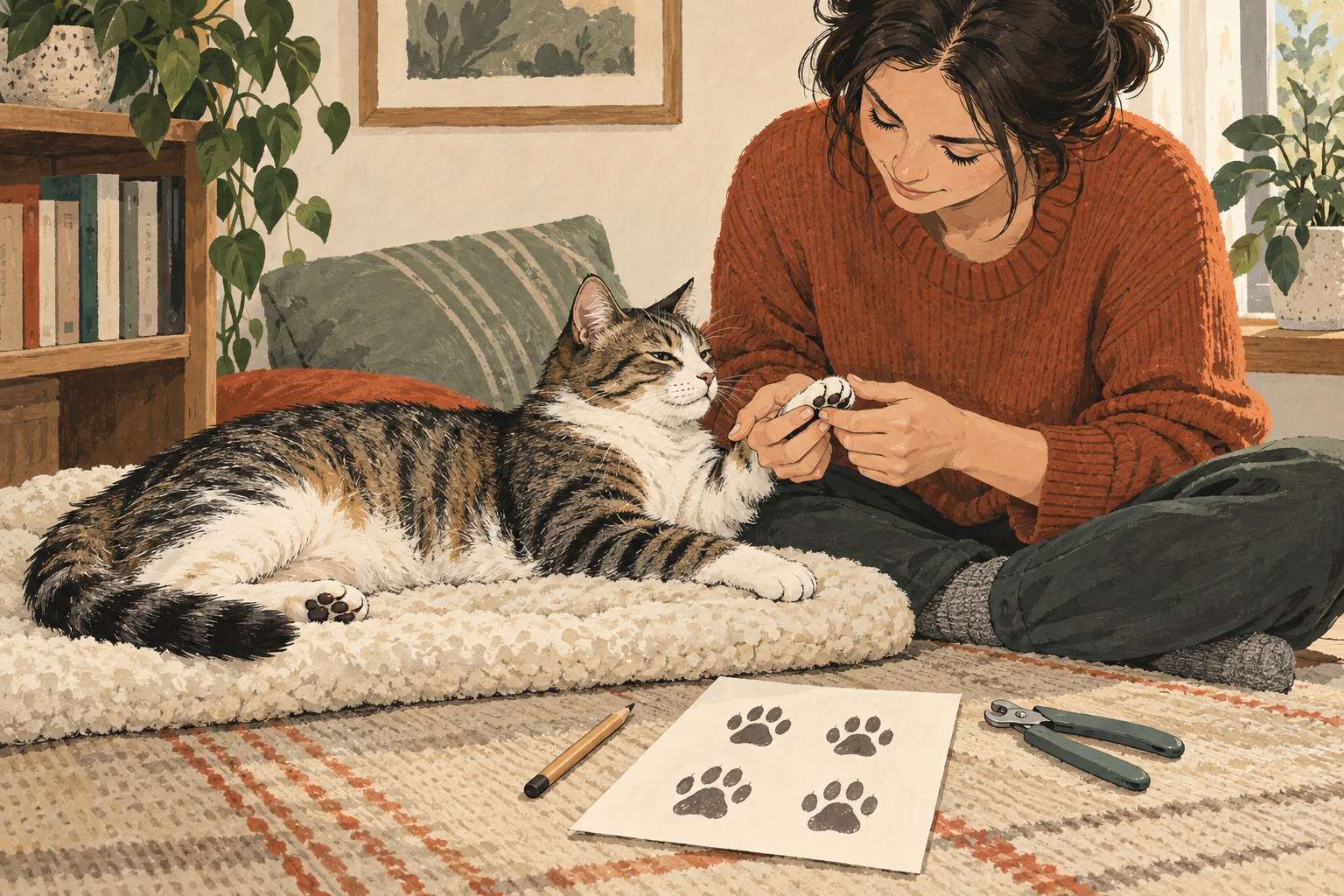
Inspect and record each claw separately rather than treating four finished paws as the goal. Mark a claw for trimming when it is noticeably longer than that cat’s usual baseline or has been snagging; leave unchanged claws for monitoring. Most importantly, stop when your cat becomes upset, even if only one or two nails are finished. A calm partial session is preferable to forcing a complete trim. [s2]
This paw-by-paw map is designed for uneven claw growth and short handling windows. It turns “finish the cat” into three smaller jobs: inspect every location, identify the current priorities, and calmly complete whatever the cat tolerates. The record also prevents an easy-to-reach front paw from being trimmed repeatedly while a back paw or dewclaw is continually forgotten.
Build a map that names every location
On paper, draw four simple paw shapes or create four headings: left front, right front, left back and right back. Give every visible claw its own line. Add separate entries for any dewclaws you find rather than assuming they were covered during a front-paw check. Back paws and dewclaws should be inspected regularly, especially when claws are becoming long or snagging. [s3]
Use consistent location codes if space is limited. For example, write LF, RF, LB and RB for the paws, then number the claws in the same direction each time. The numbering is merely an organizing convention; consistency matters more than the direction you choose. Write “dewclaw” in full until checking it becomes habitual.
- Create one line for each claw you can inspect, including separate dewclaw lines.
- Record the inspection date at the top so the map remains a snapshot rather than a permanent verdict.
- Note “not seen” or “not handled” instead of guessing about a claw you could not inspect.
Assign a traffic-light status
Give each mapped claw one of three statuses. Green means monitor: it looks consistent with your cat’s recent baseline and has no recorded snagging. Amber means consider trimming: it appears longer than before or has repeatedly caught on fabric. Red means do not improvise: the claw appears to need prompt attention, but the cat will not tolerate the necessary handling, or you are not confident about proceeding.
HumanePro advises checking nails every two to four weeks. Indoor cats, older cats and cats whose claws snag fabric may need more frequent trims. [s1] Treat that interval as a reminder to inspect, not a requirement to cut every claw. Your map can show that one claw has changed while its neighbors remain green.
- Green: write the date and leave the claw alone for this session.
- Amber: add the reason, such as “longer than last check” or “snag reported.”
- Red: stop attempting that claw and record what prevented safe, calm handling.
- If uncertain, choose monitor or professional help rather than turning uncertainty into a guess.
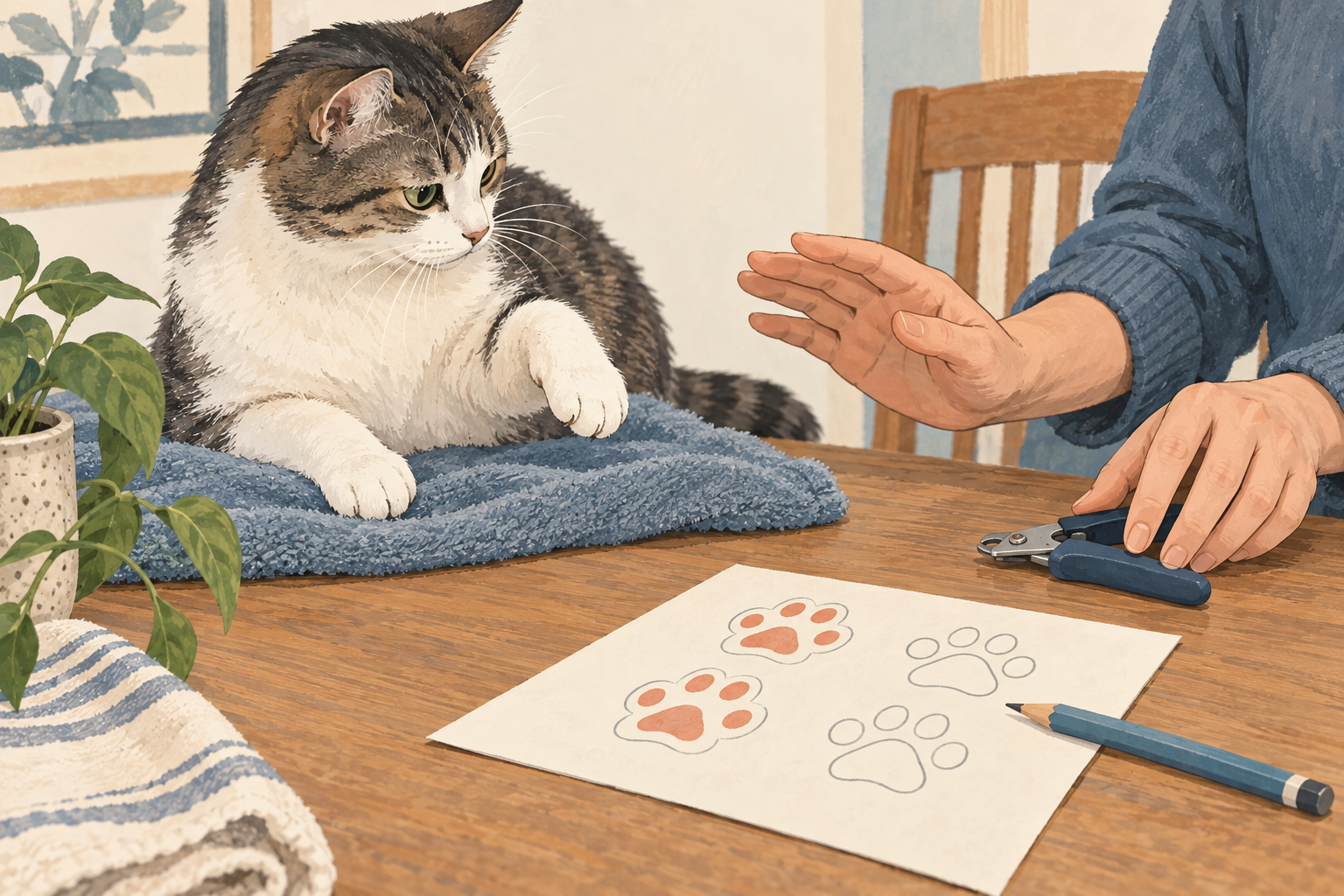
Choose priorities before touching a paw
Circle a small number of amber entries as today’s priorities. Put a frequently snagging claw ahead of one marked only for comparison, and prioritize a previously skipped dewclaw when it can be approached calmly. This queue keeps you from spending the cat’s limited tolerance on already-green claws.
Prepare the map, trimming tool, reward and any supplies you normally use before beginning. Select a comfortable setting and decide what completion will mean today: perhaps one priority claw, one paw inspection, or a brief handling practice. Completion should describe the planned task, not demand four finished paws.
VCA recommends gradual acclimation that begins with comfortable foot handling, then progresses from one nail to two or three and eventually a paw. Reaching a full trim may take several weeks. [s4] A map supports that progression because handling practice can be logged even when no clipping occurs.
- Set out everything you need before inviting the cat into position.
- Circle today’s first-choice claw and one optional next choice.
- Write a modest session goal that can be met without finishing every paw.
- Keep unselected green claws out of the session plan.
Preselect stop signals, not just goals
Before starting, choose observable behaviors that will end the session for your cat. Possible personal stop rules include repeated paw withdrawal, escalating attempts to leave, or an inability to settle after a pause. These are not a scoring system or a universal diagnosis; they are promises made in advance so that “just one more” does not replace judgment in the moment.
Also stop when your own control or visibility is poor. Mark the unfinished claw and return another time instead of rushing because the tool is already in hand. If the cat resists restraint, VCA advises stopping and contacting a veterinarian. Professional trimming is also recommended when nails need immediate attention but the cat will not tolerate the procedure. [s5]
- Write down the cat-specific behavior that means “pause” and the behavior that means “session over.”
- End immediately when the chosen stop signal appears; do not renegotiate mid-session.
- Stop if you cannot clearly see or steadily manage the selected claw.
- Record the remaining amber claws as future priorities, not failures.
Log calm completions and skipped claws
Afterward, record five fields: date, paws inspected, priority claws attempted, number calmly completed, and the reason the session ended. Add a short note about any claw whose status changed. “Calmly completed” is more useful than a total alone because it preserves the distinction between a short cooperative session and a forced finish.
Copyable log: “Date: ____. Paws inspected: ____. Dewclaws checked: ____. Green claws: ____. Amber claws and reasons: ____. Red or deferred claws: ____. Calmly completed: ____. Stop signal observed: ____. First priority next time: ____.” Keep successive entries together so changes are easier to compare.
- Count only claws completed before a stop signal appeared.
- Name the exact location of every deferred claw.
- Carry the highest-priority unfinished entry into the next inspection.
- Treat a calm inspection with no trimming as a valid logged session.
Worked example: two claws, then stop
Suppose a cat permits only brief front-paw handling. During inspection, the owner marks most claws green, one right-front claw amber because it has been snagging, and the left dewclaw amber because it looks longer than at the previous check. The back paws are recorded as inspected but unchanged. The owner circles the snagging claw first and the dewclaw second.
The first claw is calmly completed. After the dewclaw, the cat repeatedly pulls the paw away—the owner’s preselected stop signal. The session ends with two calm completions, even though another paw was available. The log names no unfinished priority, records the stop behavior and schedules the next inspection rather than adding unnecessary claws to this session.
In a different session, the owner might inspect every paw but trim nothing because handling tolerance is low. That result is still informative: the map identifies which claws remain green, which need another look and whether professional help should replace repeated attempts. Success is an accurate map plus respect for the stop rule, not four finished paws.